
French wheel with La Partage
Zero lands and half your even-money stake comes back instead of the whole lot going. On red/black, odd/even and high/low that drops the price to 1.35%. Nothing else in the lobby is cheaper to sit at.
European, French & Lightning
Four wet days in Berhampur got me an exercise book and two hundred spins of FairPlay roulette at ten rupees a go. Every bet on a European layout charges the same 2.70%, so the felt is a menu of volatility rather than a menu of prices. Below: the payout table, the doubling ladder in rupees, and what my three columns actually showed at the end of it.
Payout Chart
Read the right-hand column downwards and the whole game gives itself away. Seven different bets, seven different payouts, and an identical 2.70% charge on each of them.
| Bet | Covers | Pays | Wins | House edge |
|---|---|---|---|---|
| Straight up | 1 number | 35 : 1 | 2.70% | 2.70% |
| Split | 2 numbers | 17 : 1 | 5.41% | 2.70% |
| Street | 3 numbers | 11 : 1 | 8.11% | 2.70% |
| Corner | 4 numbers | 8 : 1 | 10.81% | 2.70% |
| Six line | 6 numbers | 5 : 1 | 16.22% | 2.70% |
| Column or Dozen | 12 numbers | 2 : 1 | 32.43% | 2.70% |
| Red/Black, Odd/Even | 18 numbers | 1 : 1 | 48.65% | 2.70% |
One pocket is held back, and that is the whole game. A European wheel pays you as though it had thirty-six pockets while the ball is running over thirty-seven. Back a single number and 35 to 1 is thirty-six-pocket money on a thirty-seven-pocket shot. Back red and even money is the same trade with eighteen numbers instead of one. The shortfall never moves, which is why no arrangement of chips on the layout is cleverer than any other. The only figure you can genuinely change is the one on the table sign above your seat.
Which Table
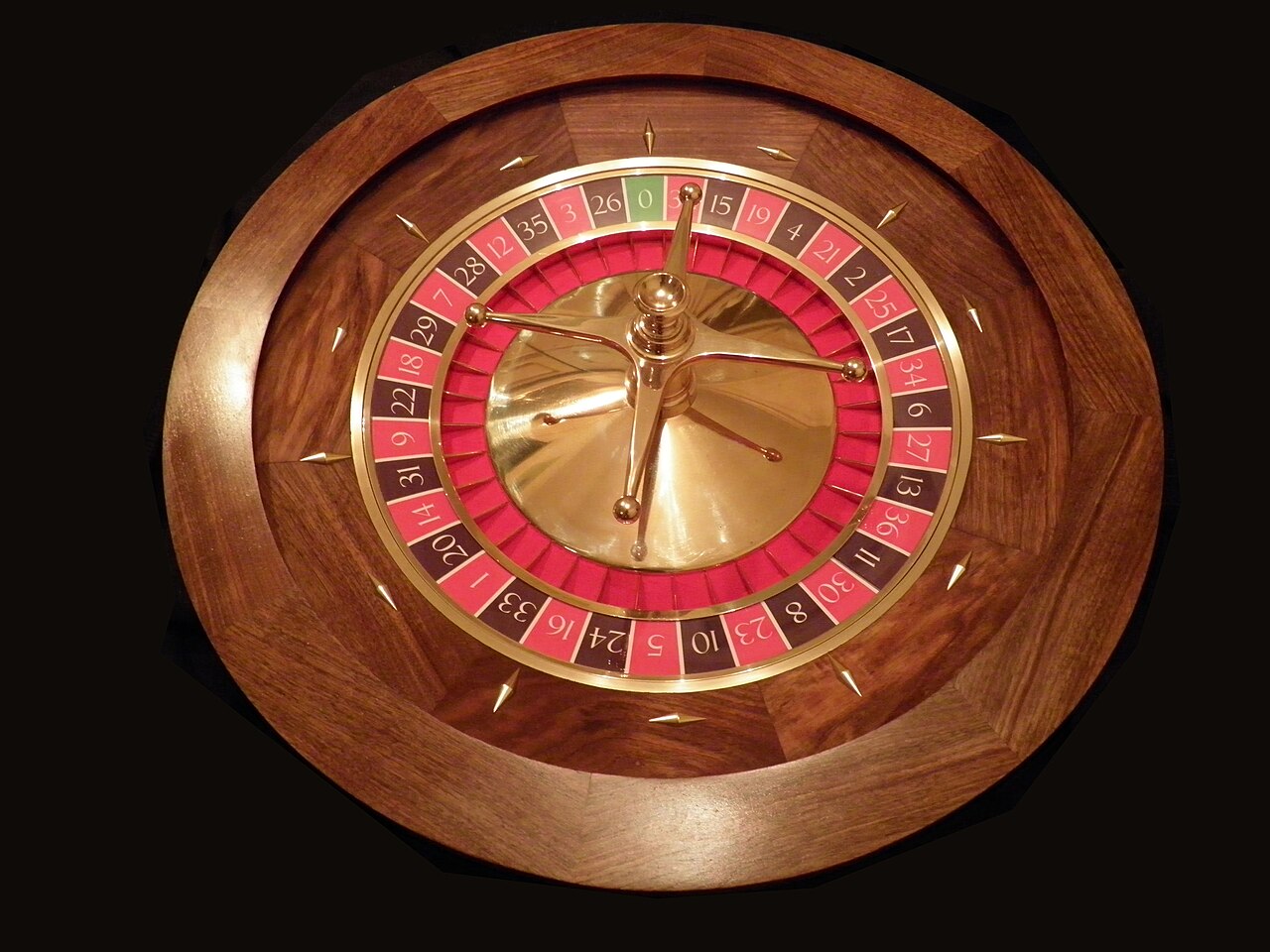
Six versions of one game, priced anywhere from 1.35% to 5.26%. Reading the table name properly is worth more than every chip decision you will make once you are seated.
Zero lands and half your even-money stake comes back instead of the whole lot going. On red/black, odd/even and high/low that drops the price to 1.35%. Nothing else in the lobby is cheaper to sit at.
One zero among thirty-seven pockets and a flat 2.70% wherever the chip goes. There is nothing wrong with it. This is the wheel most people should be playing.
Two zeros, thirty-eight pockets, 5.26%. The felt looks the same and the spin feels the same, and you pay very nearly double for that. No version of this arrangement helps you.
A handful of numbers pick up multipliers each round, running as high as 500x. The money for those comes out of straight-up wins on the numbers that were not multiplied, which pay under 35:1.
A real wheel, a real croupier and about twenty seconds on the clock to get chips down. Far fewer spins per hour than software, which is exactly why an hour there costs less at the same stake.
The other zero rule, kept on some French tables. Your even-money bet is locked up for one more spin rather than half of it being pushed back to you. It lands in much the same place.
The System, Priced
More people bring the Martingale to a wheel than bring anything else. Here is every rung it builds from a ₹100 opening bet, and how regularly the ladder runs out of wall.
| After this many losses | Next stake | Total staked |
|---|---|---|
| 1st bet | ₹100 | ₹100 |
| 2nd | ₹200 | ₹300 |
| 3rd | ₹400 | ₹700 |
| 4th | ₹800 | ₹1,500 |
| 5th | ₹1,600 | ₹3,100 |
| 6th | ₹3,200 | ₹6,300 |
| 7th | ₹6,400 | ₹12,700 |
| 8th would be | ₹12,800 | ₹25,500 |
Seven straight losses is roughly a 0.94% sequence, near enough one in 106. An even-money bet on a European wheel goes down 51.35% of the time, so that run is something you meet on an ordinary Thursday rather than once in a career. By the seventh rung the ladder has pushed ₹12,700 across the table in pursuit of a ₹100 profit, and the next rung wants ₹12,800 on its own. In practice the table maximum turns you away first, which is the part nobody reads until it happens.
That October the Bay had a depression parked on it and Berhampur went four days without proper daylight. Water stood at Tata Benz Chhak deep enough that the autos were going the long way round through Kamapalli, and my delivery shifts were cancelled two evenings running. My room is on the top floor of a lane behind Bada Bazaar, above a shop that sells Berhampuri silk, and in weather like that the ceiling fan only pushes the damp from one corner to another. The television downstairs stayed on the whole time, an Odia news channel redrawing the storm track every twenty minutes and the same three men arguing about it in between.
I had been playing roulette for about a year by then, mostly badly. If you had asked me at the end of any session whether I was up or down, I could not have told you honestly. So on the second wet evening I walked down to the stationer near Giri Market, bought a school exercise book, and ruled it into three columns: spin number, stake, running balance. Not a system. A record. Everything below came out of those columns rather than out of a strategy article.
The first column was deliberately boring: ₹10 on black, every spin, no thinking allowed. Ten rupees is where the software wheels open, so that is the smallest honest unit available. Two hundred spins took a little over two and a half hours with tea breaks in it, which put ₹2,000 of stakes through the wheel. At 2.70%, ₹2,000 of turnover carries an expected cost of ₹54. I wrote that figure at the top of the page before the first spin, which turned out to be the single most useful thing I did all week.
The balance column then did what balance columns do. Around spin 63 I was ₹80 in front and feeling reasonably clever about it. By spin 140 I was ₹210 behind and had stopped feeling clever. I finished the evening ₹90 down, which sits close enough to the ₹54 I had written at the top that the arithmetic clearly held. What surprised me was not the ending. It was the distance the line travelled to get there, and how completely that distance had fooled me every time I had played without writing anything down.
Beside the flat column I ran a second experiment. A separate ₹10 a spin, straight up on 26, for 37 spins. Thirty-seven pockets and thirty-seven spins felt like a fair trade to me at the time. Three hundred and seventy rupees went in. Nothing came back. Not one hit in the entire run, and I sat there at the end genuinely convinced the table had something against me.
Work out the chance of a chosen number missing every spin in a run of thirty-seven and it comes to 36.3%. Better than one time in three. Stretch the run to a hundred spins and there is still a 6.5% chance of nothing at all. My blank column was not misfortune, it was the ordinary behaviour of a 2.70% event, and it will happen to roughly one in three people who try what I tried.
The pairing of the two columns is what taught me something. The expected cost of ₹370 of turnover is about ₹10. I lost the whole ₹370. Meanwhile the flat black column pushed more than five times that amount through the same wheel at the same price and came out ₹90 light. Same edge, same evening, wildly different experience. That gap between the two columns is the only real difference between a straight-up bet and an even-money one, and the payout chart above says so in a single column of identical percentages.
Once you have written it down, the per-spin price stops being the interesting number and speed takes over. A live dealer wheel turns over somewhere around forty spins in an hour, because a croupier has to clear the layout, spin, wait and pay out, and you get about twenty seconds on the clock to place chips. Forty spins at ₹10 is ₹400 of stakes, and 2.70% of ₹400 is roughly eleven rupees an hour.
A software wheel has no croupier and no clock. Say you push three hundred spins through in an hour, which is not hard at all once you settle into the rhythm. That is ₹3,000 of turnover at the same stake, and the same 2.70% now costs about eighty rupees an hour. Nothing about the price changed. The wheel simply asked you the question seven or eight times more often. If you want a long evening from a small balance, the slow table is the one that gives it to you, and live tables are where the slow wheels live.
There is one decision on this game that genuinely moves money, and it is over before you place anything. Put the same ₹2,000 of stakes through three different wheels and the expected cost reads roughly ₹27 on a French table with La Partage, about ₹54 on a European one, and around ₹105 on an American wheel. Same chips, same rhythm, same felt design. Nearly four times the price between the cheapest seat and the dearest.
La Partage does that by changing one small thing: zero lands and half your even-money stake is returned instead of swept away, which takes red/black, odd/even and high/low from 2.70% to 1.35%. It only applies to those even-money bets, so a straight-up number on the same French table is still charged at the normal rate. The American wheel goes the other way for the same reason in reverse. A second zero, thirty-eight pockets, and 5.26% on absolutely everything. Read the table name. It takes ten seconds and it outperforms every hour of thought you might put into where the chips go.
The following week I tried doubling, because everybody does. Base of ₹100 on red, double after every loss, back to ₹100 after a win. For about forty minutes it was the most reassuring thing I have ever done at a table. Small win, small win, a loss recovered on the next spin, small win again. My notebook was filling up with neat little hundreds and I remember thinking that the people who called it nonsense had probably never actually run it.
Then the ladder climbed. Four losses in a row put me on the fifth rung at ₹1,600, with ₹3,100 already across the table chasing a ₹100 profit. It came in, and the relief was out of all proportion to the hundred rupees it earned me. The table below shows what waits two rungs further up: ₹12,700 staked after seven losses, and a ₹12,800 bet needed to keep going. Seven in a row is around a 0.94% run, about one sequence in 106, which is an evening rather than a lifetime.
The trick the Martingale plays is a scheduling trick. It does not alter the 2.70% on any individual spin, because nothing can, and no arrangement of stake sizes changes the value of a string of independent bets. What it does is reorder your results so the small wins arrive early and often and the one enormous loss arrives late. People remember the forty minutes and blame the wheel for the minute that ended it.
Every table hangs a list of recent results where you cannot miss it. That list is completely accurate and completely useless for predicting anything. The wheel keeps no record of its own past. A run of eight reds leaves the next spin at 48.65% red on a European wheel, exactly where it was before, and the number that has been missing for two hundred spins is in no way owed to you.
Roulette does more damage with this than any other game in the building, because it is the game that shows you the history and then immediately asks you to bet on the future. My own notebook nearly became the same trap. I caught myself on the third evening flicking back through the pages looking for numbers that were somehow due, which is precisely the thing the record was supposed to protect me from. The casino page sets out why independence between rounds sits underneath every game on the site.
Nothing above needs a deposit to be useful, but if you want to sit at a wheel and try the three columns yourself, the order goes like this. Run FairPlay register first, which wants a mobile number, an OTP and a password, and takes about as long as ordering food. Come back later through the FairPlay login screen with the same number. There is no separate Berhampur build and no local table list: the wheels load in the same order here as they do for anyone else, on the same wallet and the same login screen. FairPlay India covers what the account looks like from this side of the country.
For money in and out, UPI is the rail almost everyone here uses, and the deposit page walks through it properly, with withdrawals covered separately. Two things worth doing on the first evening. Finish the account verification before you play rather than on the night you want to take money out, because that is when a missing document is most annoying. And read any bonus terms for how table games count towards turnover, since roulette usually contributes at a lower rate than the headline number suggests.
Once you start reading about roulette you will be found by people selling ways to beat it. The predictor app that watches the last hundred numbers and tells you what is coming. The Telegram channel with a formula and a monthly fee. The video where a man explains that casinos do not want you to know this, then puts a payment link underneath.
Hold each one against the arithmetic on this page. No program can read a spin that has not happened. What those apps actually do is log the same history the table already prints on the wall and charge you for the reading. If a method genuinely returned better than 2.70%, the person holding it would use it quietly instead of selling it in instalments to strangers. Their income is the subscription, not the wheel. That is the whole business model, and it works on the person, not on the table.
The other one to refuse is the agent account. Somebody offers to open an ID for you, top it up from their own balance, take a cut, and hand you the login details. What you actually get is a stranger holding your money and your password, and no way to prove any of it is yours when the arrangement sours. Open your own account with your own number and keep the credentials where they belong. Anybody messaging you an offer to manage your wheel play is managing themselves.
Software wheels open from ₹10, live tables generally start between ₹50 and ₹100, and inside and outside bets keep separate minimums and maximums that are shown before you take a seat. The maximum is the number to read, because it is the wall the doubling ladder eventually meets. Deposit and session limits sit in your account settings, and they hold a line far more reliably than a good intention does at eleven at night; responsible gaming lists all of them in one place.
The exercise book is still on my shelf, more than a year on, with the storm days at the front of it. What it changed was not my results, which are roughly what a 2.70% charge says they should be. It changed what I notice. I sit at French tables when they are running, I take the slow live wheel over the fast software one when I want the evening to last, and when the balance line wanders I already know it wanders. Three ruled columns and a pen from Giri Market. It remains the cheapest thing I have ever bought for this game.
FAQ
Prices, wheels, droughts and the systems that do not survive contact with the arithmetic.
On a single-zero wheel, no, and that is genuinely useful to know. A straight-up number at 35 to 1 and red at even money both carry a 2.70% house edge, and so does everything in between. The reason is that you are paid as though the wheel had thirty-six pockets while the ball is actually running over thirty-seven. What changes across the layout is how violently your balance moves, not what the evening costs you.
It roughly doubles the price. Thirty-seven pockets and one zero gives you 2.70%. Add a second zero for thirty-eight pockets and the figure goes to 5.26%. Put ₹2,000 of stakes through each wheel and the expected cost is about ₹54 on the European table against roughly ₹105 on the American one, for a game that looks and plays the same. If both are open, the American wheel is simply the more expensive seat.
It changes what happens to your even-money bet when zero comes up. Rather than losing the stake outright you get half of it back, and that one rule takes red/black, odd/even and high/low from 2.70% down to 1.35%. On ₹2,000 of turnover that is about ₹27 of expected cost instead of ₹54. It only touches even-money bets, so a straight-up number on the same French table still costs 2.70%.
It cannot, and the ladder shows why. Even money on a European wheel loses 51.35% of the time, so seven losses back to back is about a 0.94% sequence, near enough one in 106. That is an ordinary evening, not a freak. From a ₹100 base those seven bets have already put ₹12,700 across the table and the eighth rung asks for ₹12,800. Either the table maximum refuses it or your balance does, and that single run swallows every small win the method produced.
Much longer than one in thirty-seven makes it sound. Run the numbers and a chosen number fails to show at all across 37 spins 36.3% of the time, and still misses across 100 spins 6.5% of the time. So roughly one session in three where you back a number for a full thirty-seven spins ends with nothing at all. That is not a cold wheel. Stake for the gap rather than for the payout and single numbers stop hurting.
It is accurate and it forecasts nothing. Those numbers already happened, and the wheel has no way of knowing them. After a run of reds the next spin is still 48.65% red on a European wheel, and a number missing for two hundred spins is no more likely than the one that just landed. Roulette hurts people here more than any other game because it hands you a scoreboard and then invites you to bet on what comes next.
From the ordinary straight-up wins. Before the spin, somewhere between one and five numbers are drawn out and given multipliers of roughly 50x up to 500x. Land on a multiplied number with a straight-up bet and you are paid at that rate rather than 35 to 1. To fund it, straight-up wins on the numbers that were not chosen pay less than a standard wheel would give you. The big nights are financed by the quiet ones.
Software wheels open from about ₹10 a bet. Live dealer tables generally start somewhere between ₹50 and ₹100, and the VIP rooms go well above that. Inside and outside bets carry their own separate minimums and maximums, and both are printed on the table before you take a seat. Read the maximum properly rather than the minimum, because the maximum is the number that ends any doubling ladder.
No software reads a wheel that has not been spun yet. The apps log past numbers and dress the log up as a forecast, which is the history board with a subscription attached. Anyone genuinely beating 2.70% would keep quiet and play, not sell the method for a few thousand rupees on a Telegram channel. Their earnings come from the fee. Treat a guaranteed roulette formula as a paid product with no product inside it.
The same way as anywhere else. There is no Odisha edition of the lobby, no separate Berhampur wheel and no local table list. Open an account, add money through UPI, and the wheels appear in the casino tab in the same order you would see them in Cuttack or Chennai. Start on the ₹10 software wheels for a session or two while you learn where the chips go, then move to the live tables once the twenty-second clock feels comfortable.
Explore FairPlay